


【IELTS-Writing & Reading-08】IELTS Simon Writing Task1 Academic Part-2 Line graphs (Simon 學術寫作任務 1 第 2 部分 線圖)
IELTS Simon Writing Task1 Academic Part-2 Line graphs
(Simon 學術寫作任務 1 第 2 部分 線圖) Key Phrases used in the video amount of electricity produced source of electricity provided electricity generating electricity (power) means of electricity generation over a period of or over the period shown by far the most important a negligible amount Nuclear power overtook thermal power as the primary source of electricity rose dramatically to a peak of by contrast the figure for remained at this level, remained stable 【寫作 (Writing)】 結構: 2任務,60分鐘。 Task 1(20分鐘,150字):圖表/流程描述(學術組)或書信(培訓組)。 Task 2(40分鐘,250字):議論文/問題解決。 高分技巧: Task 1:清晰描述趨勢/比較數據;書信注意語氣。 Task 2:明確論點,結構清晰(引言、主體、結論)。 使用多樣句型與高級詞彙。 留5分鐘檢查語法與拼寫。 練習常見題型(如原因、解決方案)。 Structure: 2 tasks, 60 minutes. Task 1 (20 minutes, 150 words): Charts/process (Academic) or letter (General Training). Task 2 (40 minutes, 250 words): Essay (argument/problem-solution). High-Score Tips: Task 1: Clearly describe trends/compare data; use appropriate tone for letters. Task 2: Clear thesis, structured (intro, body, conclusion). Use varied sentence structures and advanced vocabulary. Reserve 5 minutes to check grammar/spelling. Practice common topics (causes, solutions). 【閱讀 Reading 】 結構: 3篇文章,40題,60分鐘。 學術組:學術文章;培訓組:廣告、指南等。 題型:選擇、配對、填空、判斷(T/F/NG)、標題配對。 高分技巧: 快速掃讀(skimming)找主旨。 精讀(scanning)定位答案。 管理時間,每篇20分鐘。 注意同義詞與改述。 先易後難,跳過卡題。 Structure: 3 passages, 40 questions, 60 minutes. Academic: Scholarly articles; General Training: Ads, guides. Question types: Multiple choice, matching, fill-in-the-blank, T/F/NG, heading matching. High-Score Tips: Skim for main ideas. Scan for specific answers. Manage time: 20 minutes per passage. Note synonyms and paraphrasing. Skip tough questions, tackle easier ones first. Essay People find it very difficult to speak in public or to give a presentation before an audience. Do you think public speaking skill is really important? Give reasons. Some people say public speaking should be taught at school. Do you agree or disagree? Example Answer Public speaking and oration are the most valued skills that an individual can possess. The most influential prophets and leaders are laconic speakers and can sway their audiences verbally. The Powerful oratory skills of many leaders have won wars, averted mass panic, and saved companies from financial disaster. Unfortunately, speaking in public is not easy today. In the following paragraphs, I shall delve into the importance of the skill of public speaking. I believe that it should be a part of the school curricula. To begin with, public speaking is interrelated with communication skills and can be described as a form of communication. The forms of public speaking are an interview, speaking to a group of interviewers, and a class presentation. In such situations, if you can communicate properly, it can help you shape up your future. Secondly, it helps to overcome fear. The major reason is that one has to gather a thorough knowledge of the subject matter on which one has to speak. Once a person goes into the depth of any topic, he realizes that his anxieties and fears associated with it go down quite remarkably. Furthermore, this skill helps in personality development. When a person successfully delivers a good speech, it gives a sense of self-worthiness. A positive response from the audience can help a person feel more confident. Thus, it can bring about a lot of improvement in one?s overall personality. ?????? The art of public speaking improves relationships. Even in one?s professional life, effective interaction with one?s boss, clients or subordinates can help a person enhance the possibility of advancement in his chosen profession. Moreover, schools should emphasize on practical skills rather than theoretical skills. A good illustration of this could be India's prime minister, who claimed that before taking his designation he had to take classes to speak in front of audiences, but rather than taking classes it will benefit the students to be taught about public skill in school. In conclusion, I believe that it is very difficult to talk in front of people but, it would become easy when school authorities take an action to promote students to speak in front for audiences with extra curriculum activities. Essay
Some people think that too much money has been spent looking after and repairing old buildings, so we should knock down old buildings and build modern ones instead. To what extent do you agree or disagree? Example Answer It has been a matter of intense debate for quite some time now as to what should be done with old buildings. Some people insist that money should be spent to construct new buildings instead of maintaining obsolete ones. However, I object to the idea that people would be better off if they abolish old buildings and build new ones. To begin with, there are many arguments in favour of demolishing old buildings. There are many memorable buildings closely correlated with people's lives that money cannot compensate for the value of them. Such buildings should be demolished, even if they have an emotional value for the owners. The maintenance costs of such buildings which are in very bad shape are much more than the cost of demolishing and building new ones instead. However, it seems that knocking down the old building would cause some people do not respect their history. The reason often given is that people would lose the existence of building which can remind them of the past. There are some old buildings, which give a unique identity to a place, and with a little maintenance can be used effectively even today. For example, the Sainik School of Kapurthala was the home the maharaja of Kapurthala, Jagatjit Singh. It is a magnificent piece of architecture and is now serving a very good purpose. In conclusion, the decision to preserve or demolish old buildings should be made after considering many factors. If the old building can be used effectively or be made into a tourist attraction or is giving a unique identity to a place, it should be preserved. If a building is occupying a lot of space and is unfit to live in, then it should be demolished. Essay The government should control the amount of violence in films and on television in order to decrease the violent crimes in society. To what extent do you agree or disagree? Example Answer It is an undeniable fact that films and TV programmes are filled with violence, and as a result, violence is increasing in our societies. I agree that censoring such programmes and films, some amount of violence can be decreased. In the following paragraphs, I shall put forth my arguments to support my views. Reducing the amount of violence on TV and in the cinema would certainly be a good start to decreasing violence among people. There are many harmful effects of such programmes on individuals and society. The most disturbing effect is on the children and youth. The primary concern is that media violence may cause aggressive or criminal behaviours in people, especially in youth. For example, young kids are likely to imitate the heroes they see in the movies, who have been engaging in more violent behaviour in recent years. Moreover, media violence can stimulate fear in some children as it frightens them, making the effects long-lasting. It is a well-known fact that the media possesses a lot of power to influence people. As a result, the young teens may think it is cool to carry an automatic weapon and use it to knock off the bad guys.? Consequently, society suffers as the streets are full of violence. In conclusion, having a check on the violence in TV programmes and films would certainly be a good start to decrease violence and crime in society. The government should regulate and monitor violent contents in television and movies in order to reduce the crimes rates. Essay
In several years, many languages may die out. Some say it is not important because if we speak fewer languages, life would be easier. Do you agree or disagree? Example Answer It is a highly debatable issue that the governments should invest money on saving minority languages or not. Some opine that it is futile to save these languages because it is more convenient to have fewer languages today. In the following paragraphs, I intend to justify this latter view. The reason why the possibility of a language dying raises so much concern for sociolinguists is that language is directly related to culture. Saving a language is one way to preserve the local culture. As a distinct language is generated with the progress of social development, it can highly represent the unique culture of a country, thereby ensuring the speakers to recognize their own identities without feel like abandoned. Beyond preserving the culture and using language as a part of the speakers' identity, a very practical reason for wanting to save a dying language is that archaeologists and anthropologists can get a wealth of information about a society from its language. If a language dies out, so does our access to direct knowledge about its customs, folk tales, and vocabulary for describing the world. However, the languages which have lost the communicative purposes will disappear eventually. The truth of ?when a language dies, a culture dies? does not imply the truth of when a language is saved, culture is so saved. The change of culture is a normal part of the law of change and we should welcome this change. The only thing that can be achieved by saving a language is for intra-linguistic studies. Therefore, it is no worth to invest financial resources on these languages because they are not used by a large number of people. To recapitulate, the idea of saving threatened languages sounds good, but it is difficult to sustain because the speakers have a right to shift to another language. Therefore, it is not important to save endangered languages. IELTS Writing Course Overview Overview, Bar Chart Examples & Exercises Line Graph Examples & Exercises Pie Chart Examples & Exercises Table Examples & Exercises Process Diagram Examples & Exercises Map Examples & Exercises Combo Examples & Exercises & Review Essay Overview & Example Breakdown Agree/ Disagree: Examples & Exercises Advantages and Disadvantages: Examples & Exercises Discussion & Problem & Solution: Examples & Exercises Two-Part/ Double/ Direct: Examples & Exercises Review, Q&A Task 2 Essay Writing Format: Words: 250+ Time: 40mins Structure: Introduction & Thesis Body Conclusion Marking Criteria Task Achievement – appropriate response to the task Coherence & Cohesion – the ability to present a well-structured essay Lexical Resource – the ability to use a range of appropriate vocabulary and to use it correctly Grammatical Range & Accuracy – the ability to use grammar correctly and to use a range of grammar forms (tenses: past, present, future) Each carries 25% of the marks. Paragraph Structure 5 Main Types of Essay Questions: Categorising Task 2 essay questions makes it easier to see how certain essay question types require certain responses to ensure the question is fully answered. Type Summary Opinion Essay (Agree/Disagree) Advantages and Disadvantages Essay Discussion Essay (Discuss Both Views ) Problem and Solution Essay (Causes and Solutions or Causes and Effects) Double Question Essay (Direct Question Essay or Two-Part Question ) Quick Summary Table Type Key Instruction Words Main Focus Opinion To what extent do you agree or disagree? State & defend your view Advantages & Disadvantages What are the advantages and disadvantages? Pros and cons (sometimes outweigh) Discussion Discuss both views and give your opinion Cover both sides + your opinion Problem & Solution What are the causes / problems and solutions? Identify issues + suggest fixes Double / Direct Question Why…? / What effects…? / Is it positive…? Answer both (or all) questions directly These five categories cover almost every Task 2 question you will see in the IELTS exam. Some questions can slightly overlap (for example, a “causes and solutions” question is usually treated as a Problem & Solution type), but the approach remains similar. Tip: Always identify the question type in the first 1–2 minutes because the essay structure changes slightly for each type. Types & Structures Opinion Essay
(also called Agree/Disagree Essay) You are asked to state your opinion and support it. Typical wording: “To what extent do you agree or disagree?” You must clearly say whether you agree, disagree, or partially agree, and explain why. Structure Introduction Sentence 1- Paraphrase Question Sentence 2- Thesis Statement Sentence 3- Outline Statement
Supporting Body Paragraph 1 Sentence 1- Topic Sentence Sentence 2/3- Explain Topic Sentence Sentence 3/4- Example Sentence 5- Concession Sentence (optional)
Supporting Body Paragraph 2 Sentence 1- Topic Sentence Sentence 2/3- Explain Topic Sentence Sentence 3/4- Example Sentence 5- Concession Sentence (optional)
Conclusion Sentence 1 - Summary Sentence 2 - Reiteration of your opinion, prediction or recommendation Advantages and Disadvantages Essay You must discuss the positive and negative aspects of a situation or trend. Typical wording: “What are the advantages and disadvantages…?” or
“Do the advantages outweigh the disadvantages?” Some versions require you to say which side is stronger. Structures Discuss the advantages and disadvantages Introduction Sentence 1- Paraphrase question Sentence 2- Outline sentence
Supporting Paragraph 1 (Advantages) Sentence 3- Topic sentence (2 Advantages) Sentence 4- Explain first advantage Sentence 5- Explain second advantage Sentence 6- Example of second advantage
Supporting Paragraph 2 (Disadvantages) Sentence 6- Topic sentence (2 Disadvantages) Sentence 7- Explain first disadvantage Sentence 8- Explain second disadvantage Sentence 9- Example of second disadvantage
Conclusion Sentence 9- Summary of main points Do the advantages of this outweigh the disadvantages? Introduction Sentence 1- Paraphrase question Sentence 2- Thesis statement (state which one outweighs the other) Sentence 3- Outline sentence Main Body Paragraph 1 (Stronger Side) Sentence 4- Topic Sentence Sentence 5- Explain why it is strong Sentence 6- Example Sentence 7- Topic Sentence Sentence 8- Explain why it is strong Sentence 9- Example Main Body Paragraph 2 (Weaker Side) Sentence 10- Topic Sentence Sentence 11- Explain why it is not strong Sentence 12- Example Conclusion Sentence 13- Summary of main points and restate position. Discussion Essay
(also called Discuss Both Views Essay) You are given two opposing views and must discuss both sides. Typical wording: “Discuss both views and give your own opinion.” You need to present both views fairly and usually state your personal opinion as well. Structure Introduction 1- Paraphrase question and/or state both viewpoints. 2- Thesis Statement 3- Outline Sentence
Main Body Paragraph 1 1- State first viewpoint 2- Discuss first viewpoint 3- Reason why you agree or disagree with viewpoint 4- Example to support your view
Main Body Paragraph 2 1- State second viewpoint 2- Discuss second viewpoint 3- Reason why you agree or disagree with viewpoint 4- Example to support your view
Conclusion Sentence 1- Summary Sentence 2- State which one is better or more important Problem and Solution Essay
(also includes Causes and Solutions or Causes and Effects) You identify problems/causes and propose solutions or discuss effects. Typical wording: “What are the causes of this problem and what solutions can you suggest?” or “What problems does this cause and how can they be solved?” Structure Introduction 1- Paraphrase Question 2- Outline Sentence
Main Body Paragraph 1 1- State Problems 2- Explain First Problem 3- Explain Second Problem 4- Example of Second Problem
Main Body Paragraph 2 1- State Solutions 2- Explain First Solution 3- Explain Second Solution 4- Example of Second Solution
Conclusion 1- Summary Double Question Essay
(also called Direct Question or Two-Part Question Essay) You are asked two (or sometimes three) specific direct questions. Typical wording: “Why is this happening? Is this a positive or negative development?” You must answer both questions clearly and in separate paragraphs. Structure Introduction 1- Paraphrase Question 2- Outline Sentence (mention both questions)
Main Body Paragraph 1 1- Answer first question directly 2- Explain why 3- Further explain 4- Example
Main Body Paragraph 2 1- Answer second question directly 2- Explain why 3- Further explain 4- Example
Conclusion 1- Summary Common Mistakes Opinion Essay (Agree/Disagree) Mistakes Here are the most common mistakes candidates make in IELTS Writing Task 2 Opinion Essays (also called Agree/Disagree or "To what extent do you agree or disagree?" essays). These errors often prevent candidates from reaching Band 7+ in Task Response (25% of the score), even if their English is strong.
1. Not Stating a Clear Opinion (or "Sitting on the Fence") Mistake: Writing vague statements like "There are advantages and disadvantages, so it is hard to say" or discussing both sides without committing to a position. Why it hurts: Examiners expect a clear stance from the introduction onwards. Neutral or balanced writing without a definite opinion lowers your Task Response score significantly. Fix: Clearly state your position in the introduction (e.g., "I completely agree," "I strongly disagree," or "I partially agree because..."). Maintain the same opinion throughout the essay — do not change it in the body or conclusion.
2. Confusing Opinion Essay with Discuss Both Views Mistake: Treating the question as a discussion essay by equally presenting arguments for and against without giving your own view, or saying "This essay will discuss both sides and give an opinion at the end." Why it hurts: Opinion essays require you to argue one clear position (fully agree, fully disagree, or a nuanced but clear partial agreement). Discussing both sides neutrally is for a different question type. Fix: Focus only on supporting your opinion. If you mention the opposing view, use it briefly as a concession (1-2 sentences) and then refute it.
3. Weak or Missing Thesis Statement in the Introduction Mistake: A long background sentence, copying the question, or a weak thesis like "I think it’s good." Why it hurts: The introduction must paraphrase the question and clearly outline your position + main reasons. Fix: Standard structure: Paraphrase the statement. State your opinion clearly. Briefly outline the two main reasons you will discuss.
4. Inconsistent Position Throughout the Essay Mistake: Agreeing in the introduction but introducing contradictory ideas in the body paragraphs or conclusion. Why it hurts: This confuses the reader and damages coherence + task response. Fix: Decide your position during planning and stick to it. Every paragraph must support your overall view.
5. Underdeveloped Ideas or Insufficient Explanation Mistake: Listing points without explaining them (e.g., "This is bad because of pollution" with no further development) or using very short paragraphs. Why it hurts: You need to extend ideas with reasons, explanations, and relevant examples. Single-sentence ideas score low. Fix: Each body paragraph should have: Topic sentence (linked to your opinion). Explanation (why this is true). Example or further development. Link back to the question.
6. Poor Essay Structure or Missing Paragraphs Mistake: No clear introduction/conclusion, mixing ideas in one paragraph, or writing 3+ body paragraphs with too many ideas. Why it hurts: IELTS expects a logical 4-paragraph structure for most opinion essays. Fix: Recommended structure: Introduction (paraphrase + opinion + outline). Body Paragraph 1 (first supporting reason). Body Paragraph 2 (second supporting reason). Conclusion (summarise opinion without new ideas).
7. Overusing Memorised Phrases or Templates Mistake: Starting with "In the modern era..." "Since the dawn of time..." or "This essay will discuss both sides..." Why it hurts: Examiners spot memorised language easily, and it can lower your score for naturalness and lexical resource. Fix: Use natural, topic-specific language. Vary linking words instead of mechanical "Firstly, Secondly, Thirdly."
8. Informal Language, Repetition, or Basic Grammar and Collocation Errors Mistake: Using "kids," "stuff," "I think it's good" repeatedly, or errors like "depends of" instead of "depends on," subject-verb disagreement, or article mistakes. Why it hurts: Writing Task 2 must be formal and academic. Fix: Proofread for common personal errors. Aim for a range of vocabulary and accurate grammar. Avoid repeating the same words/phrases.
9. Not Planning or Going Off-Topic Mistake: Starting to write immediately without analysing the question or planning ideas. Why it hurts: Leads to irrelevant points or only partially addresses the prompt. Fix: Spend 5–8 minutes planning: underline key words, decide your position, and brainstorm 2 clear reasons with examples.
10. Weak Conclusion or Introducing New Ideas Mistake: Ending abruptly, copying the introduction, or adding new arguments in the conclusion. Fix: Summarise your opinion and main points in 2–3 sentences. No new information.
Quick Tips to Avoid These Mistakes and Aim for Band 7+ Always answer the exact question (not the general topic). Aim for 270–300 words (under 250 loses marks). Use clear paragraphing and a range of cohesive devices (not just "and," "but"). Develop ideas deeply rather than breadth (2 strong reasons are better than 4 weak ones). Practise with real past questions and get feedback.
Mastering the clear position and proper development of ideas is the biggest game-changer for most candidates in Agree/Disagree essays. Focus on these areas during practice, and your Task Response and Coherence scores will improve noticeably. Advantages and Disadvantages Essay Mistakes Here are the most common mistakes candidates make in IELTS Writing Task 2 Advantages and Disadvantages Essays. This question type has two main variations: Type 1: "What are the advantages and disadvantages...?" (No opinion needed — just discuss both sides.) Type 2: "Do the advantages outweigh the disadvantages?" or "Do the benefits outweigh the drawbacks?" (Requires your clear opinion on which side is stronger.) Many candidates lose marks in Task Response (the most important criterion) by mixing up these types or failing to develop ideas properly.
1. Not Identifying the Exact Question Type Mistake: Treating every adv/disadv question the same — e.g., giving a strong opinion in a pure "What are the advantages and disadvantages?" question, or forgetting to state whether advantages outweigh disadvantages when asked. Why it hurts: Examiners penalise you heavily for not addressing all parts of the task. A pure discussion without opinion scores lower if opinion is required, and vice versa. Fix: Read the question carefully. If it says "What are the advantages and disadvantages?", discuss both sides neutrally. If it asks "Do the advantages outweigh...?", clearly state your position (e.g., "I believe the advantages outweigh the disadvantages") in the introduction and support it throughout.
2. Failing to Discuss Both Sides (or Imbalance) Mistake: Writing only about advantages (or only disadvantages), or making one side much longer/weaker than the other. Why it hurts: The task requires coverage of both. A one-sided essay is seen as incomplete. Fix: Dedicate one body paragraph to advantages and one to disadvantages (or group them logically). Aim for roughly equal development, unless the "outweigh" question justifies slight imbalance in your evaluation.
3. No Clear Opinion When Required (or Sitting on the Fence) Mistake: In "outweigh" questions, listing pros and cons without deciding which is stronger, or saying "it depends" / "both are equal" without clear justification. Why it hurts: This type explicitly asks for your view. A neutral or undecided response lowers Task Response significantly. Fix: State your opinion clearly in the introduction (e.g., "Overall, the advantages far outweigh the disadvantages because..."). Reaffirm it in the conclusion with a summary of why.
4. Listing Points Without Development or Explanation Mistake: Simply listing advantages/disadvantages (e.g., "First advantage is jobs. Second is economy.") with no explanation, reasons, or examples. Why it hurts: Band 6 or below for Task Response — ideas must be "extended and supported" with explanations and relevant examples. Fix: Use this pattern in each body paragraph: Topic sentence (main advantage/disadvantage). Explanation (why it happens or its impact). Specific example. Link back to the question.
5. Poor Structure or Mixing Ideas Mistake: Putting advantages and disadvantages in the same paragraph, writing 3+ body paragraphs, or having no clear introduction/conclusion. Why it hurts: Damages Coherence and Cohesion and makes the essay hard to follow. Fix: Standard 4-paragraph structure: Introduction: Paraphrase the question + outline main points (and opinion if required). Body 1: Advantages (usually 2 well-developed points). Body 2: Disadvantages (usually 2 well-developed points). Conclusion: Summarise key points and restate opinion (if asked).
6. Going Off-Topic or Too General Mistake: Writing about the general topic instead of the specific focus (e.g., discussing tourism in general when the question is about tourism as a main source of income in developing countries). Why it hurts: Task Response suffers when ideas are not directly relevant. Fix: Underline key words in the question during planning. Every sentence must relate directly to the prompt.
7. Weak Introduction or Conclusion Mistake: Copying the question, writing a very long background, or introducing new ideas in the conclusion. Why it hurts: The introduction sets up your response; a weak one signals poor task achievement. Conclusions must not add fresh arguments. Fix: Keep the introduction short (40–60 words): paraphrase + outline. Conclusion: restate opinion and summarise without new points.
8. Overusing Memorised Phrases or Repetition Mistake: Starting with "Every coin has two sides," "In today’s world," repeating "advantage" / "disadvantage" constantly, or using mechanical "Firstly, Secondly." Why it hurts: Lowers Lexical Resource and Coherence scores. Examiners spot templates easily. Fix: Use natural, topic-specific vocabulary (e.g., "benefits," "merits," "upside," "drawbacks," "downsides," "pitfalls"). Vary linking words (e.g., "One major benefit is...," "On the other hand,...").
9. Insufficient Examples or Vague Support Mistake: Using very general or unrealistic examples, or no examples at all. Why it hurts: Ideas remain underdeveloped. Fix: Use specific, real-world examples (e.g., "For instance, in countries like Thailand..."). One well-explained example per main idea is usually enough.
10. Grammar, Vocabulary, and Word Count Issues Mistake: Frequent small errors (articles, subject-verb agreement, prepositions), informal language ("good sides," "bad sides"), or writing under 250 words. Why it hurts: Affects Grammatical Range and Accuracy, and Lexical Resource. Short essays lose marks automatically. Fix: Aim for 270–300 words. Proofread for personal error patterns. Use a mix of simple and complex sentences accurately.
Quick Tips to Avoid These Mistakes and Reach Band 7+ Spend 5–8 minutes planning: analyse the question type, brainstorm 2 advantages + 2 disadvantages, and decide your position if needed. Always address both sides — even in "outweigh" essays. Develop ideas deeply rather than listing many shallow ones. Practise with real past questions and compare your work to high-band model answers. Focus especially on Task Response — this is where most candidates drop from Band 7 to 6.
Mastering the balance between advantages and disadvantages, combined with clear development and the correct response to the question type, is the key to scoring well in this essay format. Consistent practice with feedback will help you overcome these pitfalls quickly. Discussion Essay (Discuss Both Views ) Mistakes Here are the most common mistakes candidates make in IELTS Writing Task 2 Discussion Essays (also known as "Discuss both views and give your opinion" essays). This is one of the most frequent question types. The task has three clear requirements: Discuss the first view. Discuss the second view. Give your own opinion with reasons and examples. Failing to address all three parts is the quickest way to drop to Band 6 or below in Task Response.
1. Forgetting to Give Your Own Opinion (or Giving It Too Late) Mistake: Discussing both views but only mentioning your opinion briefly in the conclusion (or not at all). Why it hurts: The question explicitly asks for your opinion. Leaving it out or hiding it until the end severely limits your Task Response score. Fix: State your opinion clearly in the introduction (in the thesis statement) and support it with reasons. Many high-band answers also refer to or reinforce the opinion in the body paragraphs (e.g., by saying which view is stronger or why one is more valid).
2. Not Discussing Both Views Properly (Unbalanced or One-Sided) Mistake: Focusing heavily on one view while barely covering the other, or only arguing your own opinion throughout (turning it into an opinion essay). Why it hurts: Examiners expect roughly balanced coverage of both views. A one-sided response is seen as incomplete. Fix: Dedicate one body paragraph to each view. Present each view neutrally and objectively (as if explaining why some people hold that opinion), then use your opinion paragraph or integrated comments to evaluate them.
3. Mixing Opinion with the Discussion of the Views Mistake: Putting your personal opinion inside the paragraphs that discuss View 1 or View 2 (e.g., "Some people think X, but I disagree because..."). Why it hurts: This can make it look like you have only discussed one view + your opinion, failing to fully address both views. Fix: Keep the discussion of each view objective and separate. Save clear evaluation and your stance for a dedicated opinion section (often a third body paragraph or strongly stated in the conclusion).
4. Listing Ideas Without Proper Development and Examples Mistake: Presenting too many reasons per view (3–4 points) but explaining none deeply, or using only one-sentence ideas. Why it hurts: Band 7+ requires extended and supported ideas. Shallow listing keeps you at Band 6. Fix: Use 1–2 well-developed reasons per view. For each reason: topic sentence → explanation (why this view exists or its impact) → specific example → link back. Quality over quantity.
5. Poor or Inappropriate Structure Mistake: Mixing both views in one paragraph, having no clear separation, writing 4+ body paragraphs, or a very weak introduction/conclusion. Why it hurts: Damages Coherence and Cohesion and makes the response hard to follow. Fix: Recommended 4- or 5-paragraph structure: Introduction: Paraphrase the question + briefly outline both views + state your opinion. Body 1: Discuss the first view (with explanation and example). Body 2: Discuss the second view (with explanation and example). Body 3 (optional but recommended): Clearly state and explain your own opinion. Conclusion: Summarise the views and restate your opinion without new ideas.
6. Weak Introduction (Overly General or Missing Thesis) Mistake: Starting with very broad statements like "This is a controversial topic in modern society" or copying the question. Why it hurts: The introduction must show you understand the task and preview your response. Fix: Two clear parts — background paraphrase + thesis that mentions both views and your position.
7. Being Biased or Negative When Presenting the "Wrong" View Mistake: Using language like "Some people foolishly believe..." or strongly criticising one view while discussing it. Why it hurts: You must present both views fairly and neutrally before evaluating them. Fix: Use neutral phrases: "Supporters of this view argue that...", "Proponents claim...", "This perspective suggests...".
8. Insufficient Development of Your Own Opinion Mistake: Stating your opinion in one sentence without reasons or examples ("I think the second view is better"). Why it hurts: Your opinion is one of the three required elements and must be justified. Fix: Give at least one well-explained reason for your opinion, supported by an example. Explain why you find one view more convincing than the other.
9. Repetition, Memorised Phrases, or Informal Language Mistake: Overusing "On the one hand / On the other hand", repeating "some people think" constantly, or using informal words ("kids", "stuff", "good/bad sides"). Why it hurts: Lowers Lexical Resource and makes the essay sound unnatural. Fix: Vary vocabulary (e.g., "proponents", "advocates", "critics", "opponents", "this standpoint"). Use topic-specific language and a range of linking devices.
10. Going Off-Topic or Word Count Issues Mistake: Writing generally about the topic instead of directly addressing the two specific views, or writing under 250 words. Fix: Underline the exact views in the question during planning. Aim for 270–300 words. Every paragraph must relate directly to the prompt.
Quick Tips to Avoid These Mistakes and Aim for Band 7+ Spend 5–8 minutes planning: clearly identify both views + decide your opinion. Always address all three parts of the question. Develop ideas deeply rather than broadly (1–2 strong points per view/opinion). Practise with real past "Discuss both views" questions and compare against Band 8–9 model answers. Get feedback on whether your opinion is clear and sufficiently developed.
The biggest differentiator between Band 6 and Band 7+ in Discussion essays is balanced coverage + clear, justified opinion + well-extended ideas. If you consistently handle all three requirements with good development, your Task Response and Coherence scores will improve significantly. Problem and Solution Essay (Causes and Solutions or Causes and Effects) Mistakes Here are the most common mistakes candidates make in IELTS Writing Task 2 Problem and Solution Essays (also called Problem/Solution or Causes and Solutions essays). This question type usually asks you to identify problems/causes/effects and propose realistic solutions.
There are slight variations in the prompt: "What are the problems and what solutions can you suggest?" "What are the causes of this, and what solutions can you suggest?" "What problems does this cause and how can they be solved?"
Failing to address all parts of the question is one of the fastest ways to drop to Band 6 or below in Task Response. 1. Not Addressing All Parts of the Question (Unbalanced Coverage) Mistake: Focusing heavily on problems/causes while barely mentioning solutions (or vice versa), or ignoring "causes" when the question asks for them and discussing only effects. Why it hurts: Examiners expect roughly equal development of both sides. Partial answers limit your Task Response score significantly. Fix: Read the question carefully during planning. If it asks for problems + solutions, cover both. If it asks for causes + solutions, discuss causes (not just the problem itself). Aim for balanced body paragraphs. 2. Listing Problems/Solutions Without Development or Explanation Mistake: Simply listing many problems and solutions (e.g., "First problem is pollution. Second is traffic...") with little or no explanation, reasons, or examples. Why it hurts: Ideas must be extended and supported. Shallow listing keeps you at Band 6 or lower. Fix: Choose only 1–2 problems/causes and 1–2 solutions. For each: Topic sentence. Explanation (why it happens or its impact). Specific, relevant example. Link back to the question. 3. Not Linking Problems and Solutions Mistake: Discussing problems in one paragraph and solutions in another without clearly showing how each solution addresses a specific problem. Why it hurts: The essay feels disconnected, and solutions appear generic or ineffective. Fix: Explicitly link them (e.g., "One major problem is X, which leads to Y. This can be solved by Z because..."). In the solutions paragraph, refer back to the problems mentioned earlier. 4. Unrealistic, Generic, or Overly Ambitious Solutions Mistake: Suggesting impractical ideas like "Governments should ban all cars" or "Everyone should stop using plastic immediately," or very vague ones like "Education is important" or "People should be more aware." Why it hurts: Solutions must be realistic and feasible to show critical thinking. Unrealistic ideas weaken Task Response. Fix: Propose practical, implementable solutions (e.g., "Governments could introduce higher taxes on single-use plastics and invest in recycling infrastructure"). Explain how the solution would work and who should take action (governments, individuals, companies). 5. Confusing Question Types (Problems vs Causes vs Effects) Mistake: Discussing effects when the question asks for causes, or describing the general problem instead of specific causes/problems. Why it hurts: This shows misunderstanding of the task and leads to incomplete coverage. Fix: Underline key words in the question ("problems," "causes," "effects," "solutions"). Plan separately for each required element. 6. Too Many Ideas (Overloading the Essay) Mistake: Trying to cover 3–4 problems and 3–4 solutions, resulting in a list-like essay with no depth. Why it hurts: You run out of time and word count, and none of the ideas get properly developed. Fix: Limit yourself to 2 well-developed problems/causes and 2 well-developed solutions. Quality and depth are far more important than quantity. 7. Poor Structure or Weak Paragraphing Mistake: Mixing problems and solutions in the same paragraph, having no clear introduction/conclusion, or writing only 3 paragraphs total. Why it hurts: Damages Coherence and Cohesion and makes the response hard to follow. Fix: Standard 4-paragraph structure: Introduction: Paraphrase the question + outline the main problems/causes and solutions you will discuss. Body 1: Discuss the problems or causes (with explanation + example). Body 2: Discuss the solutions (linked to the problems/causes, with explanation + example). Conclusion: Summarise the key problems/solutions and restate the importance of addressing them (no new ideas). 8. Weak Introduction or Conclusion Mistake: Writing a very general background statement, copying the question, or introducing new ideas/solutions in the conclusion. Fix: Keep the introduction concise (paraphrase + brief outline). In the conclusion, briefly restate the main issues and the value of the suggested solutions without adding fresh information. 9. Overusing Memorised Phrases or Repetition Mistake: Starting with "In the modern world..." or repeatedly using "One problem is... Another problem is..." and overusing words like "problem," "solution," "people." Why it hurts: Lowers Lexical Resource and makes the essay sound unnatural. Fix: Use varied, topic-specific vocabulary (e.g., "challenge," "issue," "drawback," "measure," "approach," "tackle," "address," "mitigate"). Vary linking words naturally. 10. Exaggerated Examples or Going Off-Topic Mistake: Using dramatic or unrealistic examples (e.g., claiming a minor issue directly leads to extreme outcomes like widespread crime) or discussing unrelated aspects of the topic. Fix: Use specific, plausible real-world or hypothetical examples. Stay strictly relevant to the question prompt. Quick Tips to Avoid These Mistakes and Aim for Band 7+ Spend 5–8 minutes planning: identify the exact question type, brainstorm 2 problems/causes + 2 linked solutions, and note brief explanations/examples. Always link solutions directly to the problems/causes you mentioned. Aim for 270–300 words. Under 250 words will lose marks. Make solutions practical and explain their likely effect. Practise with real past questions (many involve traffic, environment, education, health, or technology issues) and compare your essays to high-band model answers. The key to scoring well in Problem and Solution essays is balanced coverage + clear linking between problems and solutions + deep development of a few ideas rather than listing many. If you consistently address all parts of the question with realistic, explained solutions, your Task Response and Coherence scores will improve noticeably. Double Question Essay (Direct Question Essay or Two-Part Question ) Mistakes Here are the most common mistakes candidates make in IELTS Writing Task 2 Double Question Essays (also called Two-Part Question Essays or Direct Question Essays).
This question type presents a statement or situation followed by two (sometimes three) direct questions you must answer, such as: Why is this happening? What are the effects / solutions / your opinion? It is not the same as Opinion, Discussion, Advantages/Disadvantages, or Problem-Solution essays. Treating it like one of those is a frequent error that lowers your Task Response score. 1. Not Answering Both (or All) Questions Fully Mistake: Focusing heavily on one question while barely addressing the second, or completely ignoring one part. Why it hurts: This is the biggest and most damaging mistake. Examiners expect you to address every part of the question. Answering only one part often caps your Task Response at Band 5–6. Fix: Identify both questions clearly during planning. Dedicate roughly equal space and development to each. If there are two questions, use one body paragraph per question. 2. Treating It as a Different Essay Type Mistake: Turning it into an Opinion essay (giving only your view), a Discussion essay (discussing two opposing views), or a Problem-Solution essay when the questions don’t ask for that. Why it hurts: You fail to respond directly to the specific questions asked, which damages Task Response. Fix: Answer the questions directly. For example, if the questions are “Why do people do X?” and “Is this a positive or negative development?”, explain the reasons first, then clearly state and justify whether it is positive or negative. 3. Unbalanced Coverage or Unequal Development Mistake: Writing much more on the first question and only a few sentences on the second, or listing ideas without explaining them. Why it hurts: The response appears incomplete or underdeveloped. High bands require extended and supported ideas for all parts. Fix: Plan 1–2 well-developed points for each question. Use the same depth: topic sentence → explanation → specific example → link back. 4. Weak or Missing Outline in the Introduction Mistake: Paraphrasing the statement but not clearly indicating how you will answer both questions, or writing a very generic introduction. Why it hurts: The examiner needs to see immediately that you understand and will address all parts of the task. Fix: Standard introduction structure: Paraphrase the background statement/situation. Briefly outline what you will discuss (e.g., “This essay will examine the main reasons for this trend and evaluate whether it is a positive or negative development.”). 5. Poor Structure and Paragraphing Mistake: Mixing answers to both questions in the same paragraph, writing only three paragraphs total, or having no clear separation. Why it hurts: This reduces Coherence and Cohesion and makes the essay difficult to follow. Fix: Recommended 4-paragraph structure: Introduction: Paraphrase + outline both answers. Body Paragraph 1: Fully answer the first question (with explanation + example). Body Paragraph 2: Fully answer the second question (with explanation + example). Conclusion: Summarise the main points from both questions (no new ideas). 6. Insufficient Development or Listing Ideas Mistake: Simply listing reasons or effects without explaining why they occur or their impact, or using very general/vague examples. Why it hurts: Ideas remain superficial. Band 7+ requires clear extension and support. Fix: For each main point: state it → explain the reason/impact → give a relevant, specific example (real-world or hypothetical but plausible). 7. Not Stating a Clear Position When Required Mistake: When the second question asks for your opinion (e.g., “Do you think this is positive or negative?”), sitting on the fence or giving a very unclear stance. Why it hurts: The question requires a clear view with justification. Fix: Clearly state your position (e.g., “Overall, I believe this is largely a negative development because…”) and support it with reasons and examples. Avoid “it depends” unless you can explain both sides convincingly. 8. Overusing Memorised Phrases or Generic Language Mistake: Starting with “In today’s modern world…” or repeatedly using mechanical phrases like “The first question is… The second question is…”. Why it hurts: Lowers Lexical Resource and makes the writing sound unnatural. Fix: Use natural, topic-specific vocabulary and varied linking words. Refer directly to the questions without labelling them as “first” and “second” in the body. 9. Going Off-Topic or Misinterpreting the Questions Mistake: Writing generally about the broad topic instead of directly answering the specific questions asked. Why it hurts: Task Response suffers when ideas are not fully relevant. Fix: Underline the exact two questions during planning. Every paragraph must directly respond to one of them. 10. Weak Conclusion or Introducing New Ideas Mistake: Ending abruptly, copying the introduction, or adding fresh information/solutions in the conclusion. Fix: Briefly summarise the key points from both questions and restate your overall view (if relevant) in 2–3 sentences. Quick Tips to Avoid These Mistakes and Aim for Band 7+ Spend 5–8 minutes planning: break down the two questions, brainstorm 1–2 ideas for each, and note examples. Always answer both questions equally and directly. Aim for 270–300 words. Use clear topic sentences that show which question you are addressing. Practise with real past double-question prompts (common topics include technology, education, environment, work, and society) and compare your essays to Band 8–9 model answers. Get feedback specifically on whether you have fully and equally addressed both parts. The key to success in Double/Two-Part Question essays is direct, balanced, and well-developed answers to each specific question, combined with logical structure. Unlike other essay types, there is no need to discuss opposing views or weigh advantages/disadvantages unless the questions explicitly ask for it. Mastering this format will help significantly, as it appears regularly in the exam. Top 10 Mistakes Here are the most common mistakes in IELTS Writing Task 2 that keep many candidates stuck at Band 6 or 6.5 instead of reaching Band 7+. Task 2 is worth twice as much as Task 1, so avoiding these errors has a big impact on your overall Writing score.
1. Not Fully Addressing the Question (Task Response) This is the single most damaging mistake. Problem: Misunderstanding the question type, only answering one part of a two-part question, going off-topic, or writing a general essay instead of responding directly. Fix: Spend 2–3 minutes analyzing the question. Underline key words, identify the task type (Opinion, Discussion, Advantages/Disadvantages, Problem/Solution, etc.), and plan to cover all parts. Clearly state your position in the introduction and maintain it.
2. Weak or Missing Clear Position / Thesis Statement Problem: Sitting on the fence, having no clear opinion, or changing position halfway through. Fix: For opinion essays, clearly say “I strongly agree…” or “This essay will argue that…” in the introduction. Keep your stance consistent. Avoid vague neutrality if the question asks for your view.
3. Poor Essay Structure and Paragraphing Problem: Not enough paragraphs (e.g., only 2–3 long ones), no clear introduction/conclusion, ideas mixed in one paragraph, or using bullet points/sub-headings. Fix: Standard 4-paragraph structure (or 5 for some essays): Introduction (paraphrase + thesis) Body Paragraph 1 (main idea + explanation + example) Body Paragraph 2 Conclusion (summary + restate position) Leave a line between paragraphs.
4. Underdeveloped Ideas and Lack of Examples Problem: Listing ideas without explanation or support (e.g., “This is good because…” without developing it). This limits your Task Response and Coherence scores. Fix: Use PEEL structure: Point → Explain → Example (or evidence) → Link back to the question. Use specific, relevant examples rather than personal stories or over-generalizations.
5. Forcing Advanced Vocabulary or Repetition Problem: Memorizing and inserting complex words incorrectly (“Forcing vocabulary”), or repeating basic words (good, bad, people, think). Fix: Prioritize accuracy and natural collocations over rare words. Use topic-specific vocabulary and synonyms naturally. Focus on precision first.
6. Grammar Errors and Limited Range Common issues: Subject-verb agreement Article misuse (a/an/the) Tense inconsistencies Preposition errors Run-on sentences or fragments Fix: Aim for a mix of complex and simple sentences with high accuracy. Band 7 needs mostly error-free writing with a range of structures. Proofread for these at the end.
7. Poor Coherence and Mechanical Linking Problem: Overusing “Furthermore,” “Moreover,” or using linking words inaccurately. Ideas don’t flow logically. Fix: Use a variety of cohesive devices naturally (while, whereas, as a result, this is because, for instance). Ensure each paragraph has one clear central idea.
8. Time Management and Word Count Issues Problem: Writing too little (<250 words = penalty), spending too long on Task 1, or writing a very long essay full of errors. Fix: Aim for 260–290 words. Spend ~5 minutes planning, 30–32 minutes writing, and 3 minutes checking. Practice under timed conditions.
9. Informal Language or Memorized Templates Problem: Using contractions, slang, overly personal language, or obvious memorized phrases that don’t fit the essay. Fix: Keep a formal, academic tone. Paraphrase the question in your own words rather than copying.
10. No Planning or Rushing Straight into Writing Problem: Leads to disorganized ideas and missed opportunities for development. Fix: Always spend 3–5 minutes brainstorming and outlining your main ideas and examples.
Quick Tips to Reach Band 7+ Task Response: Answer all parts fully with a clear position. Coherence & Cohesion: Logical structure and natural linking. Lexical Resource: Wide range + accurate word choice. Grammatical Range & Accuracy: Variety + mostly error-free. Practice with real past questions and get feedback. Read high-band model answers to internalize good structure.
Avoiding these mistakes through deliberate practice can help you move from Band 6 to 7 (or higher) relatively quickly. Focus especially on question analysis and idea development — these two areas make the biggest difference. Would you like common mistakes for specific essay types (e.g., opinion, discussion, problem/solution) or sample corrections? Good luck with your preparation! Probability of Appearing on the Test (General estimation) Top 8 Common Mistakes to Avoid Misunderstanding the Question - Many test-takers misunderstand the question, leading to off-topic essays. Poor Time Management - Struggling to manage time effectively often results in incomplete essays. Lack of Ideas - Difficulty generating relevant ideas quickly. Weak Evidence- Weak examples can undermine arguments, and don’t provide a strong essay. Disorganised Structure - Failing to organise thoughts into clear, logical paragraphs. Grammar Errors - Frequent grammar errors can significantly lower the writing score. Limited Vocabulary - Using a limited vocabulary makes it hard to express ideas effectively. Incorrect Word Count - Not meeting the required word count can negatively affect the score. Which structure is least balanced, A, B, or C? Answer A is the least balanced.
The examiner can see that the introduction is overdeveloped, and Body 2 (one of the main points) is underdeveloped. Body paragraphs need to be similar in length, with each point supported and sufficiently developed for task response. This imbalance will limit your chances of achieving a band score of 7. In this case, the student spent too long on the introduction and not enough time on developing the task response. Parts of an Essay: Structure Summary Intro Sentence(s) 1st part- Paraphrase Question - introducing the topic and giving some background facts about it (paraphrasing the question) Sentence 2nd part- Thesis Statement - your opinion in one sentence. Sentence 3rd part- Outline Statement - what you will write about in the main body paragraphs. Body Focus questions for Body Paragraphs: Topic + controlling idea (two main ideas) Conclusion Use a concluding phrase Restate the thesis statement in different words Give some personal opinions, hopes, fears, or recommendations about the future References IELTS Essay Introduction Examples How to approach writing an introduction for IELTS Task 2 essays. Two Elements of an IELTS Essay Introduction Tip: Use your time carefully. You need a good IELTS essay introduction, but do not spend too long writing it, to avoid rushing when writing your paragraphs. Paragraphs are the most important part as they contain all your supporting arguments and demonstrate how good you are at organising your ideas. You need a method to write your IELTS essay introduction fairly quickly. When you write an introduction, you should make sure you do two things: Write a sentence (or two) introducing the topic and giving some background facts about it Tell the reader what you are going to be writing about (thesis statement) Example 1 Question Blood sports have become a hot topic for debate in recent years. As society develops, it is increasingly seen as an uncivilised activity and cruel to the helpless animals that are killed. Blood sports should be banned. To what extent do you agree or disagree? Sample IELTS essay introduction: Killing animals for sport remains a contentious issue for discussion in recent times. I believe that blood sports are cruel and uncivilized and should be banned as soon as possible. Note:This does the following things: First sentence: consists of the topic plus some background facts on the topic, which have been taken from the rubric. Second sentence: gives the writer's opinion and tells us that in the essay, the writer will be arguing the reasons why it is cruel. The topic does not have to be in the first sentence, but it should be made clear somewhere in the introduction. You must always have a thesis. Paraphrasing Another important point - don't copy from the question! You must paraphrase (put it in your own words). To do this, you can use synonyms and move the order of the sentence around. Using some of the same words is acceptable, but don't copy whole phrases. Example 2 Question Science and technology have helped the world make many advances. The Arts, such as painting, theatre and dance, to name just three examples, however, are also valuable. What things do the Arts provide to the world that Science and Technology do not?Sample IELTS essay introduction: Societies have developed rapidly over time due to the many advances in science and technology. However, the arts are also very important and provide our world with many things that science and technology cannot. Example 3 Question According to a recent study, the more time people use the Internet, the less time they spend with real human beings. Some people say that instead of seeing the Internet as a way of opening up new communication possibilities worldwide, we should be concerned about the effect this is having on social interaction. How far do you agree with this opinion? Sample IELTS essay introduction: A recent study has shown that as people use the Internet more, they are spending less time with human beings. I believe that although this has increased the communication around the world in positive ways, it has also led to negative effects on the day-to-day social interaction of human beings. Example 4 Question Unemployment has become an increasing problem in the recent past. What factors contribute to an increase in unemployment, and what steps can be taken to solve the problem? Sample IELTS essay introduction: Over recent years, the level of unemployment has been increasing at an alarming rate in many countries around the world. This essay will discuss the reasons for this increase and consider what practical solutions are available. Example 5 Question Some people think children in secondary school should study international news as part of the curriculum. Others think that this would be a waste of time as there are already too many subjects for children to concentrate on. Discuss both views and give your own opinion. Sample IELTS essay introduction: While some people are of the opinion that it would be useful to include international news as a subject in the school curriculum, others believe that this is a waste of students time because they are already overloaded with subjects to study. This essay will examine both sides of the issue. More Examples The most important consideration when choosing any career or job is having a high income. To what extent do you agree or disagree?It is widely accepted that, for most people, their daily working lives will not be spent in their dream jobs. Despite this, I do not feel that people should instead prioritise becoming a higher earner above all other concerns.
In many societies in the world, the population is ageing rapidly, and this is leading to an unsustainable increase in the cost of public healthcare. A nation's population should pay for their healthcare provision in the future. To what extent do you agree or disagree?Advances in medical science are resulting in prolonged lifespans, but there is a knock-on effect for public health services, with many hospitals struggling to cope with an ageing populace. Many countries enjoy the benefits of free or subsidised national public health services. However, there are some within senior health management who claim that such provision will become unsustainable, and I firmly agree that changes need to be made in order to reflect this changing reality.
Fewer students are studying science at school and university, favouring more computer-based subjects instead. Is this a positive or negative development? What are the reasons for this?In recent years, it has become evident that there has been a shift among secondary and university students away from traditional sciences and towards IT-based subjects. In this essay, I will talk about the reasons behind this shift and explain why I think that, overall, this is a negative development.
Nowadays, technology is influencing modern art in areas such as design, painting and film. Do you think this is a positive or negative development?Nowadays, technology is influencing modern art in areas such as design, painting and film. Do you think this is a positive or negative development? Writing a Thesis Statement The thesis statement is an important part of your essay, so this lesson explains how to write thesis statements for different essay types. What is a thesis statement? It tells the reader what will be in the essay. It may also give your opinion if the question asks you for this. It is the last sentence of your introduction.~ Example Identify the task of the essay question
As global trade increases, many goods, including those we use on a daily basis are produced in other countries and transported long distances. Do the benefits of this trend outweigh the drawbacks?
Note: Your essay is going to discuss the advantages and disadvantages of this issue, and this is what needs to be made clear in your thesis statement.
It is also an opinion essay as it asks you to make a decision on whether you think there are more advantages or disadvantages.
Example Intro:
Due to the increase in global trade, many of the goods that we consume every day are made in a different country and then transported over a long distance in order to reach us. In my opinion, this trend has more disadvantages than advantages. Example 2: Blood Sports Many are against sports which involve hunting animals, as these sports are believed by people to be uncivilised and violent towards animals. In my opinion, these practices should be prohibited. This essay will discuss the dangers caused by these activities in terms of endangering rare animals as well as disrupting the ecosystem. Paragraph Writing Writing clear and well-organised paragraphs is essential for your essay, so here you will learn about the basic elements that make up a good paragraph. Example 1 Example Controlling Ideas: Trophy Hunting of rare species can lead to their extinction + Example Disturbing the natural eco-system + Example. Many are against sports which involve hunting animals, as these sports are believed by people to be uncivilised and violent towards animals. In my opinion, these practices should be prohibited. This essay will discuss the dangers caused by these activities in terms of endangering rare animals as well as disrupting the ecosystem. To begin with, hunting rare and exotic creatures as a hobby has exposed them to possible extinction. Several types of animals are declining in numbers because of these blood sports. Hunters who compete with each other to catch the rarest species have made several kinds of animals fall into the endangered category. For example, in India, killing elephants for their tusks has been a well-known practise among many poachers. As a result, many individuals have launched campaigns against these recreations, claiming that they are so cruel towards animals that are being hunted just for recreational purposes. Additionally, excessive poaching has also disrupted the environment’s ecology. Killing certain species of animals that act as natural predators for others may have considerable negative impacts on the environment. This is because numerous kinds of animals would significantly increase in numbers, while some would fall short in their numbers. As a consequence, it would affect the nutritional resources and destroy natural habitats. For instance, fishing for turtles has caused a population of jellyfish to increase rapidly. This has affected the food resources that are consumed by other fish. In conclusion, many people have campaigned against these uncivilised and violent activities towards wildlife. In my opinion, the threat of extinction and environmental destruction are two key reasons why these blood sports should be banned. Example 2 Blood sports, which involve the hunting, injuring, or killing of animals for entertainment, are increasingly viewed as inhumane and barbaric in modern society. While some defend them as cultural traditions, I firmly believe that these activities are deeply unethical and should be completely banned, as they reflect a cruel misuse of human power over defenceless creatures. The main argument for banning blood sports rests on the ethical duty to prevent unnecessary cruelty. Activities such as cockfighting, dogfighting, and bullfighting cause immense suffering and prolonged pain to animals. Animals used in these sports are often severely injured, stimulated with drugs to enhance performance, and eventually die for entertainment or betting purposes. In a civilised society, it is morally indefensible to inflict pain on animals, who are living creatures capable of feeling pain, solely for human amusement or financial gain. Furthermore, blood sports have a detrimental impact on human psychology, especially among children. Exposing young people to violence against animals can normalize cruelty and foster a lack of empathy, potentially leading to increased violent behavior in the future. Allowing such cruel practices to continue under the guise of "culture" or "tradition" undermines the moral progress society has made regarding animal rights. Conversely, proponents of blood sports often argue that they are part of traditional culture, such as Spanish bullfighting or Jallikattu in South India. They may also argue that these events are important for rural economies and betting industries. However, the development of modern ethics dictates that no amount of economic gain or tradition justifies cruelty. Cultural practices that involve torture or killing of living creatures should evolve, rather than being preserved at the expense of animal welfare. In conclusion, I strongly believe that blood sports should be banned globally. Society has a responsibility to protect vulnerable animals from pain and suffering, and continuing such violent traditions only serves to make the human race appear uncivilized. Governments should enforce strict laws against these acts to ensure a more humane future. IELTS Essay Conclusion Learn how to write a quick conclusion for an IELTS essay. Example - Blood Sports You should do three things in your conclusion: Use a concluding phrase Restate the thesis statement in different words Give some personal opinions, hopes, fears, or recommendations about the future
Take a look at this essay question and introduction. The thesis statement is in red: Question: Blood sports have become a hot topic for debate in recent years. As society develops, it is increasingly seen as an uncivilized activity and cruel to the helpless animals that are killed. Blood sports should be banned. To what extent to you agree or disagree? Sample IELTS essay introduction: Despite the fact that killing animals for sport is popular in modern society, it remains a contentious issue. (thesis) I believe that blood sports are cruel and uncivilized and so should be banned as soon as possible. Sample IELTS essay conclusion: In order to write the first sentence of the IELTS essay conclusion, you can paraphrase your thesis statement - remember to use a phrase to make it clear it is a conclusion. To conclude, it is clear that blood sports must be prohibited as no civilized society should allow the pain and suffering of animals simply for fun. For your final sentence, you can give some personal opinions, hopes, fears, or recommendations about the future. I hope that governments around the world discuss this issue with haste and forbid this inhumane type of sport as soon as possible. This is the full IELTS essay conclusion: To conclude, it is clear that blood sports must be prohibited as no civilized society should allow the pain and suffering of animals simply for fun. I hope that governments around the world discuss this issue with haste and forbid this inhumane type of sport as soon as possible. Assessment of your ability to understand and interpret written English in academic and general contexts. Our IELTS reading sample questions will help you understand the types of questions asked in the IELTS Academic Reading module. Exercises have a given time limit every time you practice. Topic: Continents Collide Reading > Academic > P2 > Continents Collide Writing Task 1 Writing Task 2 Academic Reading https://ieltstutorials.online/sample-questions/cue-card https://www.ieltsbuddy.com/ielts-speaking-samples.html
50 Recent IELTS Speaking Topics for Parts 2 and 3 for IELTS 2025
https://ieltsliz.com/ielts-speaking-part-1-topics/ IELTS Speaking Sample Questions with Answers for IELTS Speaking Part 3 https://www.ieltsjacky.com/ielts-speaking.html https://ieltsmaterial.com/50-ielts-speaking-part-2-3-topics-2020-with-model-answers/ https://ieltsliz.com/ielts-speaking-free-lessons-essential-tips/ https://takeielts.britishcouncil.org/take-ielts/prepare/free-ielts-english-practice-tests/speaking https://ielts-up.com/speaking/ielts-speaking-test.html https://leapscholar.com/exams/ielts/practice-test/speaking/part-1 https://ielts.org/take-a-test/preparation-resources
IELTS Speaking Band Descriptors - Speaking Assessment Criteria What is the IELTS Speaking test? Four Skills 33 interview questions for students (with sample answers) Interviewers usually ask these questions for students to learn about their basic knowledge and abilities. They also ask these questions to get a better understanding of your interests, attitude, and personality. Some common general questions include: Can you tell us about yourself? How did you learn about our organization/ university? What are your strengths? What are your weaknesses, and how do you overcome them? Why did you choose your school? What motivates you? How do you believe you can contribute to our growth? Where do you see yourself in the next five years? Can you tell us why you think you're the best fit for this role? Do you have any questions for us?
Experience and Background The interviewer may ask questions about your background and experience to understand your responsibilities in previous roles and how you handled them. They also ask these questions to envision you in the role and determine whether you fit their company culture. Below are examples of these questions: Tell us something about your field of study. Which academic accomplishment are you most proud of? Do you have prior experience in this role? Do you have any academic goals you hope to achieve before you graduate? What are they? What skills and experience do you hope to gain in this job? Do you have plans to further your education? Do you participate in any extracurricular activities? What are they? What do you wish you knew before choosing this career path? What steps have you taken for your professional growth and development? Do you think your education helped to prepare you for this role? In what way?
In-depth Questions Interviewers ask in-depth questions to get detailed information about your behaviour or abilities. These questions usually relate directly to the role and give the interviewer an idea of how well you'd perform. Examples of in-depth questions include: Can you give an example of a time you applied your leadership skills at work? How do you work under pressure? How do you handle stress? Do you prefer working alone or with a team? Why? Tell us about a time you exceeded your expectations. Have you ever missed a deadline? Why and what was the result? Describe how you organise your schedule and prioritise your tasks. Have you ever managed multiple tasks simultaneously? How did you handle them? How do you manage two projects that are due at the same time? How do you intend to make an impact in this role?
Discussion Questions (Tests) (1) What images spring to mind when you hear the word ‘test’? (2) Do you get nervous when you take tests? (3) Are there any kinds of tests that you love? (4) Do you follow any special routines before you take a test? (5) What test has made you most nervous? (6) What do you think about while you wait for the result of a test? (7) Have you ever cheated on a test? (8) Have you ever taken an IQ test? (9) Do you think testing is useful or a waste of time? (10) Do you think your test scores reflect your true ability and intelligence? (11) Do you like taking tests? (12) Are you good at taking tests? (13) What was the last English test that you took like? (14) Have you ever had a blood test? (15) Would you be more nervous before your driving test, a blood test or an English test? (16) What’s the best way to prepare for a test? (17) What medical tests have you had? (18) What was the worst test you ever took? (19) Are there too many tests in school? (20) How do you feel when you fail a test?
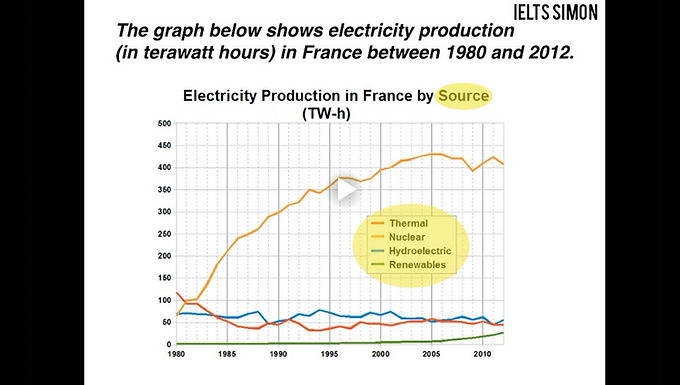
IELTS Simon Writing Task1 Academic Part-2 Line graphs (Simon 學術寫作任務 1 第 2 部分 線圖) Key Phrases used in the video amount of electricity produced source of electricity provided electricity generating electricity (power) means of electricity generation over a period of or over the period shown by far the most important a negligible amount Nuclear power overtook thermal power as the primary source of electricity rose dramatically to a peak of by contrast the figure for remained at this level,...