


【IELTS-Listening-04】How Do I Get Band 9 in IELTS Listening? (雅思聽力如何拿9分?)
【聽力(Listening)】 結構: 4部分,40題,約30分鐘(加10分鐘抄寫答案)。 Part 1:日常對話(2人)。 Part 2:獨白(生活情境)。 Part 3:學術討論(2-4人)。 Part 4:學術講座(獨白)。 題型:選擇、填空、配對、表格、地圖等。 高分技巧: 預讀題目,標記關鍵詞。 專注同義詞替換。 熟悉各種口音(英、澳、美)。 練習速記關鍵資訊。 檢查拼寫與格式(數字、日期)。 Structure : 4 sections (questions get harder as you progress) 40 questions 30 minutes (+10 minutes for answer transfer) Part 1: Casual conversation (2 people) Part 2: Monologue (daily life) Part 3: Academic discussion (2-4 people) Part 4: Monologue (Academic lecture) Question types : Multiple choice Fill-in-the-blank Matching Tables Maps High-Score Tips : Pre-read questions, highlight keywords. Watch for synonyms. Familiarize with accents ( British, Australian, American ). Practice quick note-taking. Check spelling and format (numbers, dates). Skills Assessed: Understand main ideas Understand detailed factual information Recognise the opinions and attitudes of speakers Recognise the purpose of the communication Follow the development of ideas or arguments Marking Tips: Incorrect spelling Incorrect grammar Incorrect number of words/ numbers
Word Limit: Write TWO WORDS AND/OR A NUMBER Write ONE WORD ONLY Write NO MORE THAN THREE WORDS The listening test in IELTS can be divided into four parts one of which is a conversation between two people. The conversations are mostly based on social settings. Take a test to know the type of conversation and how well you fair in it. Topic: Furniture Insurance
Find exercise: Listening > 2 People > Furniture Insurance > click square before timer IELTS Listening Practice Lessons: Multiple Choice Tips Tips on how to improve your listening skills for multiple-choice type questions.
Dealing with Listening Distractors Avoid being tricked into writing the wrong answer.
Map Labelling How to label a map, a task that sometimes comes up in Section Two of the test. Learn about the language of location and other top tips to score well.
Listening Map Labelling This is common in Section 2 , whereby one person speaking . It is quite common for the map to be related to some kind of tour . The aim in labelling a map is to connect the information that you hear to the gaps in the map. Map Types: 1. List of words - choose the correct words to fit in the map. 2. Gaps to fill from listening and choosing the right word. Example First, take a look at the map, and then read the IELTS listening map labelling tips. Map of an Outdoor Park Tips for IELTS Listening Map Labelling Read the instructions carefully - such as: the maximum number of words and / or numbers you can use – in this case it is no more than two words. Know the vocabulary of location - commonly used words to describe where things are located ( see below ). Identify where the numbers start and finish – from the example, note the first number location (15) starts at the bottom, not the top. The numbers (15, 16, 17) will follow the order of the listening. Understand the context - listen carefully at the beginning as the speaker will give you the context. ( where you are in the map for example) which will help you follow the talk. Also, look over the map. This will help you identify exactly what you are labelling - note already labelled things to get a feel for where things are. Predict the answers - try to predict what the answer might be. Look at the gaps and see if you can guess/predict what you might be labelling - a room, building, sports facility, street, etc. Pay particular attention to things close by - for example, number 15 is by the ‘ station ’ so it is quite likely that this might be mentioned just before number 15, and the answer is likely to be mentioned. Pay attention to any other clues in the map - for example, you are given a compass icon in the corner telling you where ‘ North ’, ‘ South ’, ‘ East ’ and ‘ West ’ are. This means it is likely that these phrases will be used to direct you. So listen out for them. You are also given your location - in the tower. Look at two questions at once - this is something you should always do in the listening test. If you hear the answer to question 16, you will know you missed 15. Forget about what you missed and move on . If you are only looking at 15 you could miss both and get lost. You can make a calculated guess at the end. Common Language of Location Various phrases can explain where things are, below are some of the most common phrases for IELTS listening map labelling or diagram labelling. At the top / at the bottom On the left / on the right Left-hand side / right-hand side South / North / East / West Southeast / Southwest / Northeast / Northwest To the north / to the south / to the east / to the west Opposite / in front of / behind In the middle / in the centre Above / below Inside / outside Just beyond / a little beyond / just past Next to / alongside / adjoining (= next to or joined with) Practice Now take a look at the map again below. Listening Audio Exercise What accent does she speak in? Transcript with Answers Listening Transcript Well, here we are at the top of the tower, and we're going to look at the view from each direction. Out to the east , the large buildings about a kilometer away are on the Olympic site. There's an indoor arena for gymnastics, a stadium for track and field and a swimming pool for races and synchronised swimming and also diving. If you look carefully down there, you can see the train lines. The Olympic site has its own station to encourage the use of public transport. There is also a car park, but it only holds a limited number of cars. The formal park has some specially-created water features. If you look out here to the south , you can see a circular ornamental pond. And around to the west , you can relax and sit on a bench to smell the flowers in the rose garden, and finally up to the north , if you look in front of you now, there's a lake with a small island in the centre. You can hire rowing boats at the boat shed, which you can't see from here, but if you look through the trees , you can see the cafe, which has lovely views across the water. OK, let's climb down now. We will go now and have a look at the nature reserve section of the park, which has opened up natural wetland to the public. ------------------------------------------------------------------------------------------------------------------- Common Language of Location At the top / at the bottom On the left / on the right Left-hand side / right-hand side South / North / East / West Southeast / Southwest / Northeast / Northwest To the north / to the south / to the east / to the west Opposite / in front of / behind In the middle / in the centre Above / below Inside / outside Just beyond / a little beyond / just past Next to / alongside / adjoining (= next to or joined with) -------------------------------------------------------------------------------------------------------------------
Answers: 15. car park 16. rose garden 17. cafe Maps Australian Accent Key Pronunciation and Vowel Shifts The "I" Sound: Shift to a flatter "oi" or "eye" sound. "Like" becomes "Loike," and "night" becomes "noight".
The "A" Sound: Short "a" (as in "cat") often moves closer to a short "e" (as in "egg"). "That hat" sounds like "Theht heht".
Final R sounds: Drop the 'r' at the end of words, replacing it with an "ah" sound. "Water" becomes "Wuh-tah" and "car" becomes "cah".
T sounds: Use a "flapping T" in the middle of words, so "cattle" sounds like "caddle".
Endings: Words ending in "-ing" are shortened to "-in'" (e.g., "going" becomes "goin'").
Vocal Posture and Tone Relaxed Jaw: Keep your mouth and jaw relaxed and slightly open, moving your mouth less than in American accents. Nasal Quality: The accent is generally nasal, particularly in the "broad" Australian accent. High Rising Terminal: Use an upward, questioning inflection at the end of sentences, even for statements. Exercise 2 TIPS FOR IELTS LISTENING DIAGRAM QUESTIONS Title: Always notice the heading/title of the diagram. This gives you valuable information to understand the content.
Details: Don’t get lost in trying to understand every detail of the diagram – you won’t have time. So, spot the keywords and notice which part of the diagram they relate to . IELTS do fill their listening tests with lots of information that isn’t required for answers. This is to test your ability to filter meaning and language in order to focus on your task.
Questions : Note completion – often the questions require you to fill in the gap of a note or sentence. In this case, the other words in the notes will help you understand the type of answer you are looking for, such as a noun, verb, adjective, number, etc.
Empty Gaps – you have an empty field gap relating to a part of the diagram with no extra words to help you. This usually indicates the name of that particular part of the illustration.
Location : Notice where the questions are located and what order they come in. The questions will follow the order of the recording, but are positioned in different places within the diagram.
Answers : They will come in order. You must spell the word correctly.
Instructions : Notice how many words or numbers you are allowed for your answer.
Keywords : The diagram will contain keywords that are already labelled – pay attention to them. They will help you understand the recording and keep your place in the diagram.
Always be ready to move on to the next question . It’s easy to lose your place in the recording, particularly when you are looking at the diagram as well as listening. This really is a multi-tasking listening test .
Guess : If you are not sure about an answer, don’t leave it empty – guess. Your guess might be right. Diagram Language Tips for Listening Diagrams are visual, and this means you will learn language which relates to the location of things in the diagram. Below are some examples, but you can learn many more from the transcripts for the recordings below. Always use the transcripts after you finish a lesson to enlarge your vocabulary.
at the top / at the bottom / on the side (of) to the left / on the left side / to the right / the right side / either side / both sides behind / next to / opposite / adjacent to / in front of above / on top of / below / underneath / upside down / the right way up the center / the periphery / the focal point / inside / outside
Often (not always), the person speaking will indicate when they are about to speak about the diagram. For example, they might say:
if we look at the diagram looking at the illustration as you can see by the visual representation Practice As you see, this lesson contains two types of questions. It is normal to get two or more types of questions in one section of your IELTS Listening Test. The first type of question is Sentence Completion and the second is a practice of the IELTS Listening Diagram Labelling question. The recording will not tell you when to move from one question to another – you must listen and be ready to move at the right time.
Mars Insight Probe Questions 1 – 3: Complete the sentences using no more than one word and/or a number.
The Insight probe will investigate Mars’ ……………… The probe is currently situated near Mars’ ………….. Scientists aim to learn about Mars’ composition from its core to its ………..
Questions 4 – 7 Complete the diagram below using no more than two words and/or numbers.
Recording
Listening Practice Exercises Map Listening
Signposting Language for Section 4 Section 4 is the most difficult part of the listening test. Learn useful signposting language to improve your score for this section.
Pre-Listening Activities - Predicting the Answer Predicting what you are going to hear is a really important skill that can help improve your listening and increase your score. Sentence Completion Strategies Strategies to deal with sentence completion questions. Grammar in IELTS Listening Key tips to avoid grammar errors and use grammar to get the right answer.
Listening Exercises Full Practice Listening Test One
you can input your answers onto the question sheet in the same way as the test Section 1-4
Full Practice Listening Test Two Section One - Booking a Hotel Section Two - Volunteering Abroad Section Three - A Media Studies Course Section Four - History of Indian Railways
Full Practice Listening Test Three Section One - Bus Tour of London Section Two - A Talk on Pandas Section Three - A Business Studies Course Section Four - Behaviour of Dolphins
Full Practice Listening Test Four Section One - Host Family Application Section Two - Soccer Club Meeting Section Three - A Business Case Study Section Four - Library Talk Various Listening Exercises Accademic Listening https://ieltstutorials.online/sample-questions/cue-card https://www.ieltsbuddy.com/ielts-speaking-samples.html
50 Recent IELTS Speaking Topics for Parts 2 and 3 for IELTS 2025
https://ieltsliz.com/ielts-speaking-part-1-topics/ IELTS Speaking Sample Questions with Answers for IELTS Speaking Part 3 https://www.ieltsjacky.com/ielts-speaking.html https://ieltsmaterial.com/50-ielts-speaking-part-2-3-topics-2020-with-model-answers/ https://ieltsliz.com/ielts-speaking-free-lessons-essential-tips/ https://takeielts.britishcouncil.org/take-ielts/prepare/free-ielts-english-practice-tests/speaking https://ielts-up.com/speaking/ielts-speaking-test.html https://leapscholar.com/exams/ielts/practice-test/speaking/part-1 https://ielts.org/take-a-test/preparation-resources
IELTS Speaking Band Descriptors - Speaking Assessment Criteria What is the IELTS Speaking test? Four Skills 33 interview questions for students (with sample answers) Interviewers usually ask these questions for students to learn about their basic knowledge and abilities. They also ask these questions to get a better understanding of your interests, attitude, and personality. Some common general questions include: Can you tell us about yourself? How did you learn about our organization/ university? What are your strengths? What are your weaknesses, and how do you overcome them? Why did you choose your school? What motivates you? How do you believe you can contribute to our growth? Where do you see yourself in the next five years? Can you tell us why you think you're the best fit for this role? Do you have any questions for us?
Experience and Background The interviewer may ask questions about your background and experience to understand your responsibilities in previous roles and how you handled them. They also ask these questions to envision you in the role and determine whether you fit their company culture. Below are examples of these questions: Tell us something about your field of study. Which academic accomplishment are you most proud of? Do you have prior experience in this role? Do you have any academic goals you hope to achieve before you graduate? What are they? What skills and experience do you hope to gain in this job? Do you have plans to further your education? Do you participate in any extracurricular activities? What are they? What do you wish you knew before choosing this career path? What steps have you taken for your professional growth and development? Do you think your education helped to prepare you for this role? In what way?
In-depth Questions Interviewers ask in-depth questions to get detailed information about your behaviour or abilities. These questions usually relate directly to the role and give the interviewer an idea of how well you'd perform. Examples of in-depth questions include: Can you give an example of a time you applied your leadership skills at work? How do you work under pressure? How do you handle stress? Do you prefer working alone or with a team? Why? Tell us about a time you exceeded your expectations. Have you ever missed a deadline? Why and what was the result? Describe how you organise your schedule and prioritise your tasks. Have you ever managed multiple tasks simultaneously? How did you handle them? How do you manage two projects that are due at the same time? How do you intend to make an impact in this role?
Discussion Questions (Tests) (1) What images spring to mind when you hear the word ‘test’? (2) Do you get nervous when you take tests? (3) Are there any kinds of tests that you love? (4) Do you follow any special routines before you take a test? (5) What test has made you most nervous? (6) What do you think about while you wait for the result of a test? (7) Have you ever cheated on a test? (8) Have you ever taken an IQ test? (9) Do you think testing is useful or a waste of time? (10) Do you think your test scores reflect your true ability and intelligence? (11) Do you like taking tests? (12) Are you good at taking tests? (13) What was the last English test that you took like? (14) Have you ever had a blood test? (15) Would you be more nervous before your driving test, a blood test or an English test? (16) What’s the best way to prepare for a test? (17) What medical tests have you had? (18) What was the worst test you ever took? (19) Are there too many tests in school? (20) How do you feel when you fail a test?
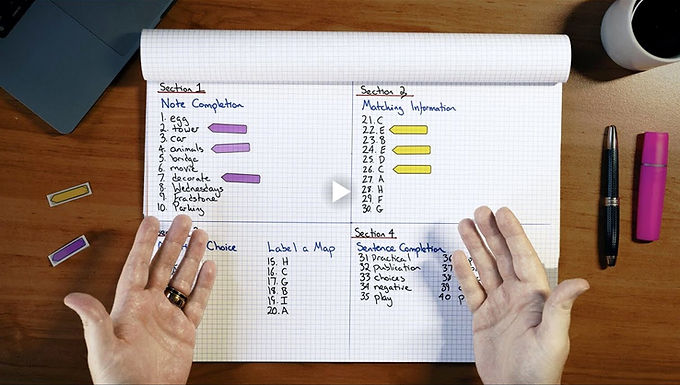
【聽力(Listening)】 結構: 4部分,40題,約30分鐘(加10分鐘抄寫答案)。 Part 1:日常對話(2人)。 Part 2:獨白(生活情境)。 Part 3:學術討論(2-4人)。 Part 4:學術講座(獨白)。 題型:選擇、填空、配對、表格、地圖等。 高分技巧: 預讀題目,標記關鍵詞。 專注同義詞替換。 熟悉各種口音(英、澳、美)。 練習速記關鍵資訊。 檢查拼寫與格式(數字、日期)。 Structure : 4 sections (questions get harder as you progress) 40 questions 30 minutes (+10 minutes for answer transfer) Part 1: Casual conversation (2 people) Part 2: Monologue (daily life) Part 3: Academic discussion (2-4 people) Part 4: Monologue (Academic lecture) Question types :...